
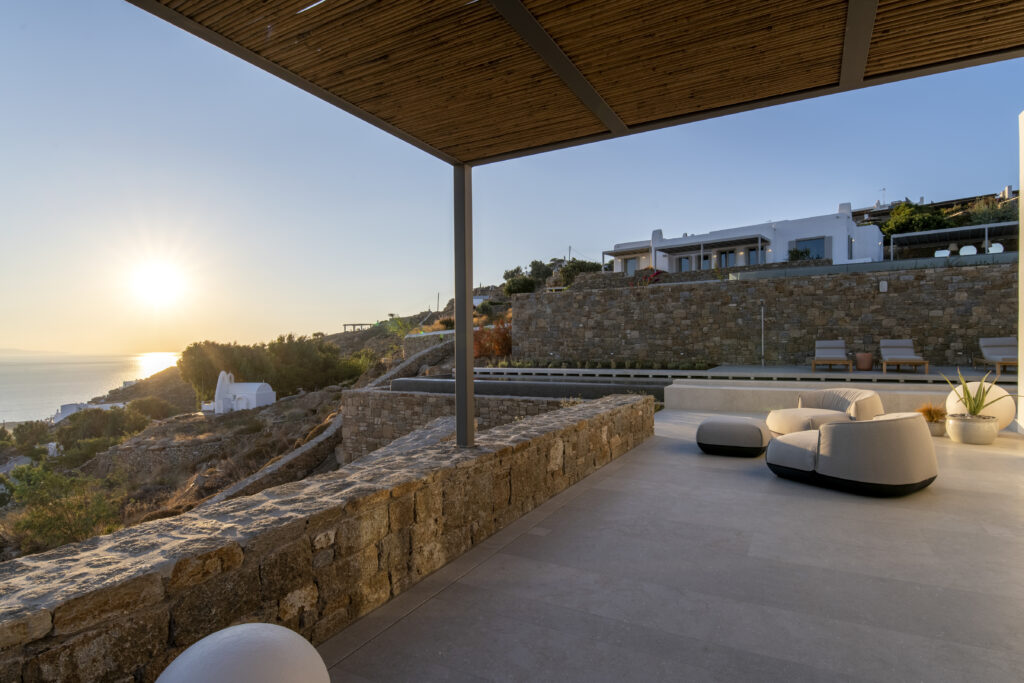
Greece Wedding Venues: Villa, Beach or Chapel?
Villa, beach or chapel: how each Greek wedding venue works legally and practically, what to check before you commit, and how to match the setting to your guest list and season.
IN THIS GUIDE
Greece gives you five main settings for a wedding: a private villa, a beach, a chapel or church, the town hall, and a hotel, estate or beach club. Legally, a Greek marriage is either civil, performed by the mayor or a municipal official, or religious, so a villa or beach ceremony is usually the symbolic celebration around that legal step. Choose by guest count, privacy and season. Our destination wedding team plans celebrations in Mykonos and Chania.
The main venue types in Greece
Wedding venues in Greece fall into five groups, and the first question is which one can legally hold the part of the day you want there. A civil marriage is conducted by municipal officials, and a religious marriage by the clergy of the relevant church. Either one is a legal marriage in Greece, and you do not need both. Everything else, from a vow exchange on the sand to a sunset blessing on a villa terrace, is a symbolic ceremony layered around that legal step.
Private villa
Ceremony, dinner and party at one address, with the wedding party sleeping on site.
Best for: intimate weddings and multi-day celebrations
Beach
Barefoot and informal, but Greek beaches are public land in common use, so set-ups need the right permissions and a plan for the wind.
Best for: small symbolic ceremonies and photographs
Chapel or church
A church wedding is a legal marriage in its own right, subject to the rules of that church and its calendar.
Best for: couples who want a religious ceremony
Town hall
The civil route, run by the municipality, with fixed days, hours and document checks set locally.
Best for: the legal formalities, with the celebration elsewhere
Hotel, estate or beach club
Venues with their own event spaces, kitchens and staff, often able to take larger guest lists.
Best for: big receptions that outgrow a private house
Private villa weddings
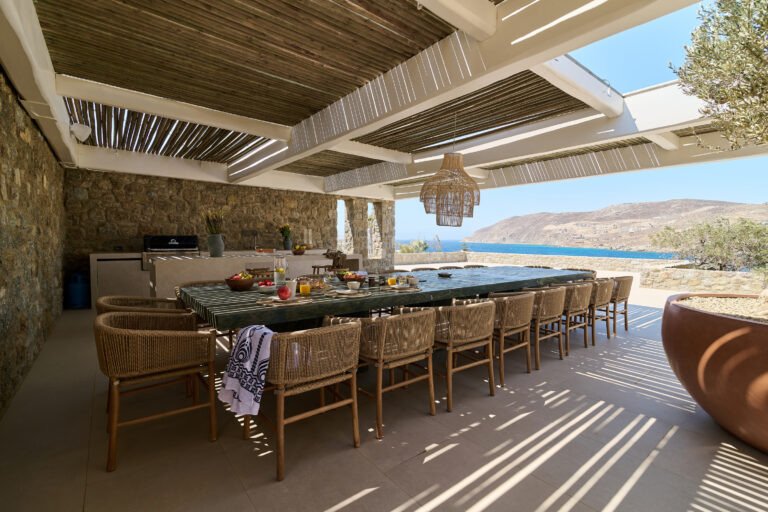
A villa wedding turns the weekend into one setting: you control the guest list, the music, the menu and the timing. For a small wedding, a large villa can house the entire party: Villa Aegeas in Ornos has 11 bedrooms for up to 22 guests, an infinity pool and an outdoor dining area for 22, and it is 4.5 km from Mykonos airport.
Villas differ widely in what they allow. A house that is perfect for a family holiday may not permit an event, amplified music or outside caterers, and a hillside plot may have little parking for guest cars. Confirm in writing, before you book, whether the owner accepts an event, the maximum number of guests on the property, any noise curfew, and where suppliers can unload.
Mykonos or Chania?
Mykonos suits couples who want the island’s energy on the doorstep, with Cycladic architecture and a lively evening for guests who stay on. Our guide to where to stay in Mykonos explains the character of each area. Chania, on Crete, is the other Greek destination in our collection, and seven of our Chania villas are in Akrotiri. If you are weighing the two islands, our Mykonos or Chania comparison sets them side by side.
Beach ceremonies and what to check
A beach ceremony is the image most couples have in mind, and the most misunderstood. Under Greek Law 2971/2001, the seashore and beach are public property managed by the State, their public use is direct and open to everyone, and their main purpose is to stay open with free access. The same law provides for concessions of these zones, which is how beach businesses operate on the sand.
In practice, this means you cannot simply rope off a public beach for a private ceremony. Anything beyond a few people standing on the sand, such as chairs, an arch, a sound system or catering, needs to be arranged with the right authority or held within an area that a beach business legally operates. Always check the current position with the local municipality and, where relevant, the concession holder, and get the arrangement confirmed in writing.
Permissions
- Who manages this stretch of beach
- Whether set-up and furniture are allowed
- Whether music and lighting are allowed
Conditions
- A sheltered spot, away from the afternoon wind
- Sunset time on your date
- A fallback plan if the wind rises
Guests
- Access for older guests on sand
- Parking or shuttle drop-off
- Shade before the ceremony
The wind deserves real attention. The etesian winds, known in Greece as the meltemi, are strong, dry north winds of the Aegean that blow from about mid-May to mid-September. They are strongest in the afternoon, often die down at night, and sometimes last for days without a break. Veils, flower arches and table linen all need to be planned around them.
A villa near the sand can give you the best of both: photographs on the beach, then the ceremony and dinner on a private terrace. Villa Kiya in Kanalia, for example, is 150 metres from the nearest beach.
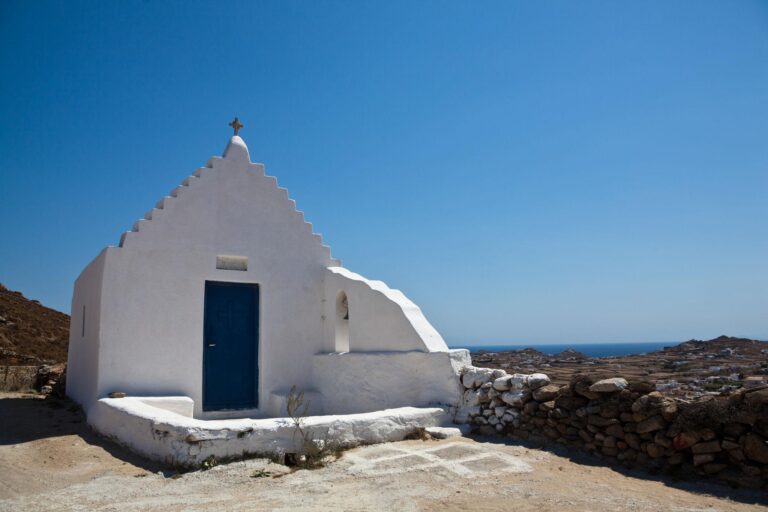
Chapels and church ceremonies
A religious marriage is legally recognised in Greece, so for many couples the chapel is the legal venue as well as the emotional one. The rules depend on the church.
Greek Orthodox weddings
Guidelines published by the Greek Orthodox Archdiocese of America state that the sacrament must be celebrated by an Orthodox priest in a canonical Orthodox church, that a non-Orthodox partner must be a Christian baptised in water in the name of the Father, the Son and the Holy Spirit, and that the Church cannot marry an Orthodox Christian to a non-Christian. The sponsor, the koumbaros or koumbara, must be an Orthodox Christian in good standing. Weddings are not celebrated during fasting seasons and certain feasts, including Great Lent, Holy Week and the Dormition fast from 1 to 15 August. Confirm dates and paperwork with the local Metropolis in Greece; the U.S. Embassy lists the Archdiocese of Athens as a contact.
Other churches
For Protestant, Roman Catholic or Jewish ceremonies, the U.S. Embassy lists community contacts in Athens and advises couples to contact the clergy directly, who may ask for baptism certificates.
The civil route
For a civil marriage, the couple applies jointly to the mayor or community president where they wish to marry, and the official sets the date. Each municipality sets its own practice. The Municipality of Mykonos’ published requirements place the civil ceremony at City Hall on Tuesdays and Thursdays within set hours, ask for two adult witnesses with passports, and ask couples to email all documents one month before the wedding. Civil marriage in Greece has been open to same-sex couples since 2024.
Choose civil or religious
Either is a legal marriage in Greece. Decide which one carries the legal weight, and where.
Gather and apostille your documents
Typically passports and birth certificates, plus proof that any earlier marriage has ended. Documents from countries outside the Hague Convention are legalised through the consulate instead of apostilled. Chania also asks couples living abroad for a marriage licence from their home authority that names both partners.
Translate into Greek
Foreign documents need the apostille first, then an official Greek translation, attached to the originals.
Submit and set the date
Send the file to the municipality or church. Chania, for instance, accepts files by email or in person and estimates four working days to process them.
Register the marriage
A marriage is not legal in Greece until it is registered at the registry office (Lixiarcheio) of the city where it took place, within 40 days.
Requirements change and differ between nationalities, so check the current list with the municipality and your embassy before you book flights.
Talk to our event planner
Tell us the date, the destination and roughly how many guests, and we will come back with the options that fit.
Matching venue to guest count and season
Guest numbers narrow the choice fastest. A villa that feels generous for 20 people can feel crowded at 80, and a beach that works for a handful of guests becomes a logistics exercise for a hundred.
| Guests | Venues that tend to work | Watch for |
|---|---|---|
| Up to 20 | A private villa, a small chapel, a symbolic moment on the beach | Villa event rules, chapel capacity |
| 20 to 50 | A larger villa with outdoor terraces, a villa plus a separate ceremony site | Parking, neighbours, noise curfews |
| 50 to 100 | A villa ceremony with a reception at a hosted venue, or an estate | Guest transport between locations |
| More than 100 | Hotels, estates and beach clubs with their own event spaces | Accommodation for everyone, timings |
Guidance only: capacity and event permissions vary by property.
Season matters almost as much. The meltemi shapes outdoor ceremonies from mid-May to mid-September, especially in the afternoon, so an evening ceremony in a sheltered spot is often the safer plan. If you want an Orthodox wedding, Orthodox guidelines published in the U.S. exclude the Dormition fast from 1 to 15 August, so confirm your date with the Metropolis first. Search interest in Greek wedding venues peaks in September, May and August, so start early if you have one of those months in mind.
Logistics: transfers, accommodation, suppliers
The other half of the plan is moving, housing and feeding your guests on an island, often across several locations in one day.
Transfers
- Professional drivers and guest transport, with cars, vans, buses and 4x4s
- Boat arrivals where a villa is close to a dock
- A timed schedule from hotels and villas to the ceremony
Accommodation
- A main villa for the couple and close family
- Nearby Mykonos villas for other guests
- Rooms held early for peak months
Suppliers
- A private chef who cooks in your villa
- Professional event security
- Florists, music and photography, booked locally
Arrival by sea can be part of the day. Villa Blue Diamond in Kalo Livadi sleeps up to 18 guests and is 300 metres from the beach and a dock for boat transfers, and 400 metres from the Kalo Livadi helipad.
Weddings, christenings, themed and corporate events are planned and run by our own team in your destination. Tell us your date, your guest count and the feeling you want, whether close and personal or large and extravagant, and we will shape the plan around you.
Frequently asked questions
Can UK citizens legally marry in Greece?
Yes. British couples can marry in Greece in a civil ceremony run by the municipality or in a religious ceremony, and either is a legal marriage there. The UK government advises checking the process and documents with the authority that registers marriages. Greek municipalities ask for apostilled documents with official Greek translations; Mykonos asks for them by email one month ahead. The marriage must be registered in Greece within 40 days.
Can US citizens legally get married in Greece?
Yes. According to the U.S. Embassy in Greece, U.S. citizens may marry in a civil ceremony, a religious ceremony or both, and either is a legal marriage. For a civil ceremony, the couple applies jointly to the mayor where they wish to marry, and the licence is generally issued eight days after the application. The marriage must be registered at the local registry office within 40 days; the Embassy does not register marriages.
What is the best month to get married in Greece?
There is no single best month; it depends on the ceremony you want. For outdoor ceremonies, the meltemi winds blow across the Aegean from about mid-May to mid-September and are strongest in the afternoon, so evening ceremonies in sheltered spots are easier. Published Orthodox guidelines exclude weddings during Great Lent and from 1 to 15 August. Search interest peaks in September and May, so plan early for those months.
How do you get married in Greece?
Choose a civil ceremony, run by the municipality, or a religious one, run by the church; either is legal. Gather passports, birth certificates and proof that any earlier marriage has ended, add the apostille, then have them officially translated into Greek. Submit them to the municipality or church, which sets the date. After the ceremony, register the marriage at the local registry office within 40 days, and check current requirements with the municipality and your embassy.
What are the best places to get married in Greece?
It depends on the wedding you want. Private villas suit intimate weddings and multi-day celebrations; beaches suit small symbolic ceremonies, subject to permissions and the wind; chapels suit couples who want a religious ceremony; hotels, estates and beach clubs suit larger receptions. In our collection, Mykonos offers villas close to its beaches and nightlife, while in Chania most of our villas are in Akrotiri.
Sources
- U.S. Embassy & Consulate in Greece, Getting Married in Greece. https://gr.usembassy.gov/getting-married-in-greece/
- Municipality of Mykonos, Requirements to Civil Weddings. https://mykonos.gr/wp-content/uploads/2017/10/Requirements-to-Civil-Wedding.pdf
- Municipality of Chania, Civil marriage for foreigners (residing abroad): Required documents & information. https://www.chania.gr/services/civil-marriage-chania-city/
- GOV.UK, Getting married or registering a civil partnership abroad. https://www.gov.uk/marriages-civil-partnerships-abroad
- InforMEA, Law No. 2971 on the seashore, the beach zone and other provisions. https://www.informea.org/en/legislation/law-no-2971-seashore-beach-zone-and-other-provisions
- Greek Orthodox Metropolis of Denver, Marriage Guidelines. https://www.denver.goarch.org/marriage-guidelines
- Wikipedia, Etesian. https://en.wikipedia.org/wiki/Etesian
- Wikipedia, Marriage in Greece. https://en.wikipedia.org/wiki/Marriage_in_Greece
Talk to our event planner
Tell us the type of celebration, the destination, the date and roughly how many guests. Your enquiry is handled confidentially by the Truman Collection event team.